Turkey has a layer of everyday medical care that most American travelers don't have at home, and not knowing it exists is how people end up in an emergency room for something a pharmacist could have handled in five minutes.
The eczane — the neighbourhood pharmacy — sits at the bottom of a ladder that runs up through walk-in private clinics to hospital emergency departments. This guide describes each rung and what it can actually do, so you can recognise which one you're looking at.
The eczane
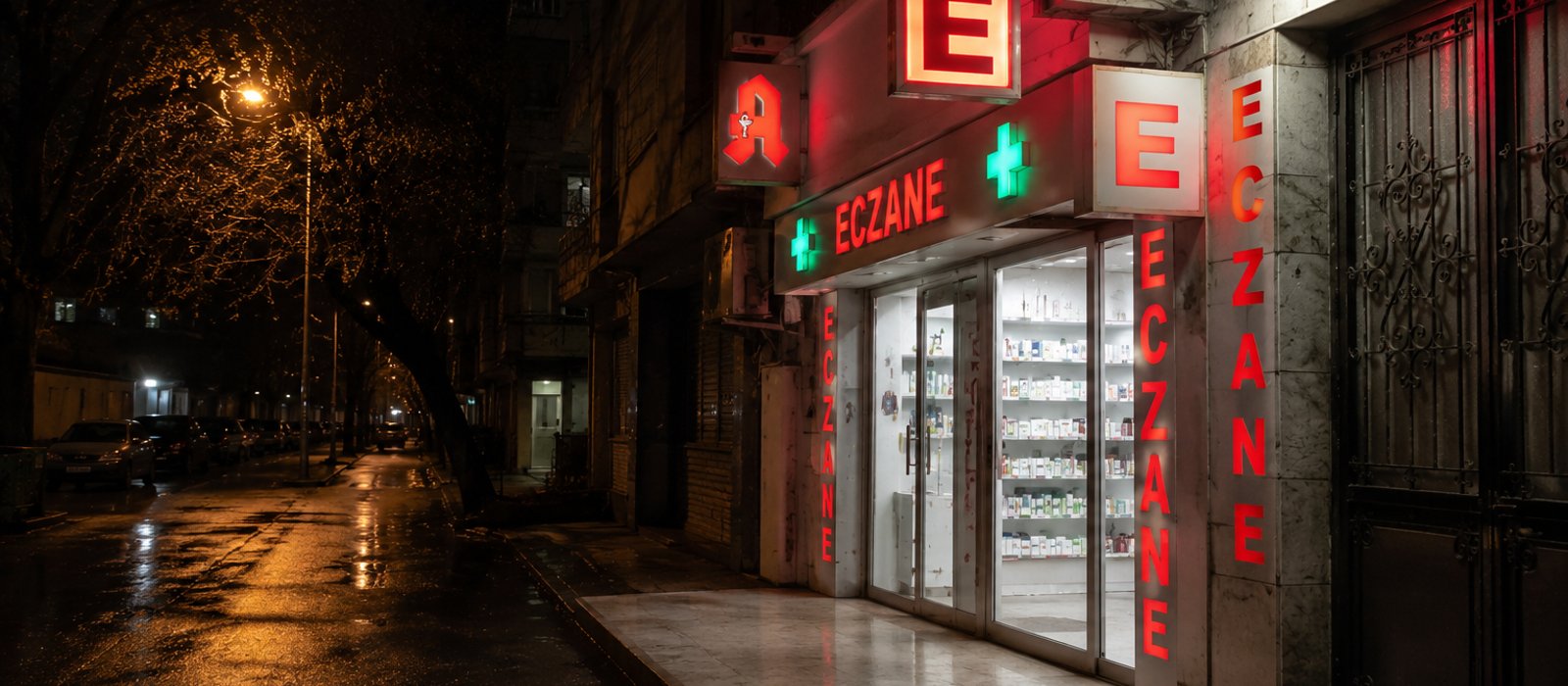
Turkish pharmacies are small, everywhere, and staffed by a licensed pharmacist who is expected to advise rather than just dispense. You'll find them by the green neon cross and the word ECZANE.
A Turkish pharmacist can dispense and advise on over-the-counter medicines and many non-controlled products without a doctor's prescription; antibiotics and controlled or prescription-only medicines require a valid Turkish physician's prescription, and foreign prescriptions are not legally recognised for dispensing.
Two things follow from that second clause, and they cut in opposite directions. The scope of what a pharmacist can help with directly is wider than an American traveler expects — the ordinary stomach upset, the sunburn, the allergic reaction, the sprain. But a prescription written in the United States has no legal standing at the counter, so a medication you take routinely at home cannot simply be reordered on production of your US paperwork.
Out of hours: the nöbetçi eczane
Pharmacies keep normal shop hours, but the system doesn't close.
Every district operates a rotating nöbetçi (duty) pharmacy open 24 hours, the rota changes daily, and closed pharmacies are required by law to display the name and address of the current duty pharmacy; duty pharmacies can also be found through the official e-Devlet query, local pharmacist-chamber lists, or a map search for "nöbetçi eczane".
The notice in a dark pharmacy window at 2am is the analogue version of that system and it works — it's a legal requirement, not a courtesy.
Walk-in private clinics
The middle rung, and the one most travelers don't know is there. Private clinics and polyclinics in cities and resort areas take walk-ins, and in tourist areas English is common.
What they handle is the band between "a pharmacist can advise on this" and "this needs a hospital": something that needs examining, an X-ray, stitches, a prescription that requires a Turkish doctor's signature. Waits are typically shorter than a hospital emergency department for the same complaint, because the complaint isn't competing with emergencies.
Consultation charges are set by each clinic and there's no published tariff for a self-paying foreign patient to check in advance — the same absence that runs through Turkish healthcare pricing generally, covered in the guide to Turkish hospital billing.